It answers in transaction codes, or it says nothing.
A specialist for SAP BRIM — Convergent Mediation, Charging and Invoicing, and FI-CA. It reads the SAP documentation for your release before it writes a word, and removes every claim that documentation does not support.
Free to use until 1 October. No card.
> AHQ 4\}=GPW3/ +FN 29]*EMU1 [&D T0 >%CKSZ6 $BJ Y5|#AHQX \}=G W3 {+FNV29 *EM 18[&DLT07>
Retrieved · ranked
- 010.97
- 020.90
- 030.83
- 040.77
- 050.71
- 060.64
0000 B59D 6A2A 1FB7 C444 79D1
Then raise the tolerance in FKKB07 and rerun the job.
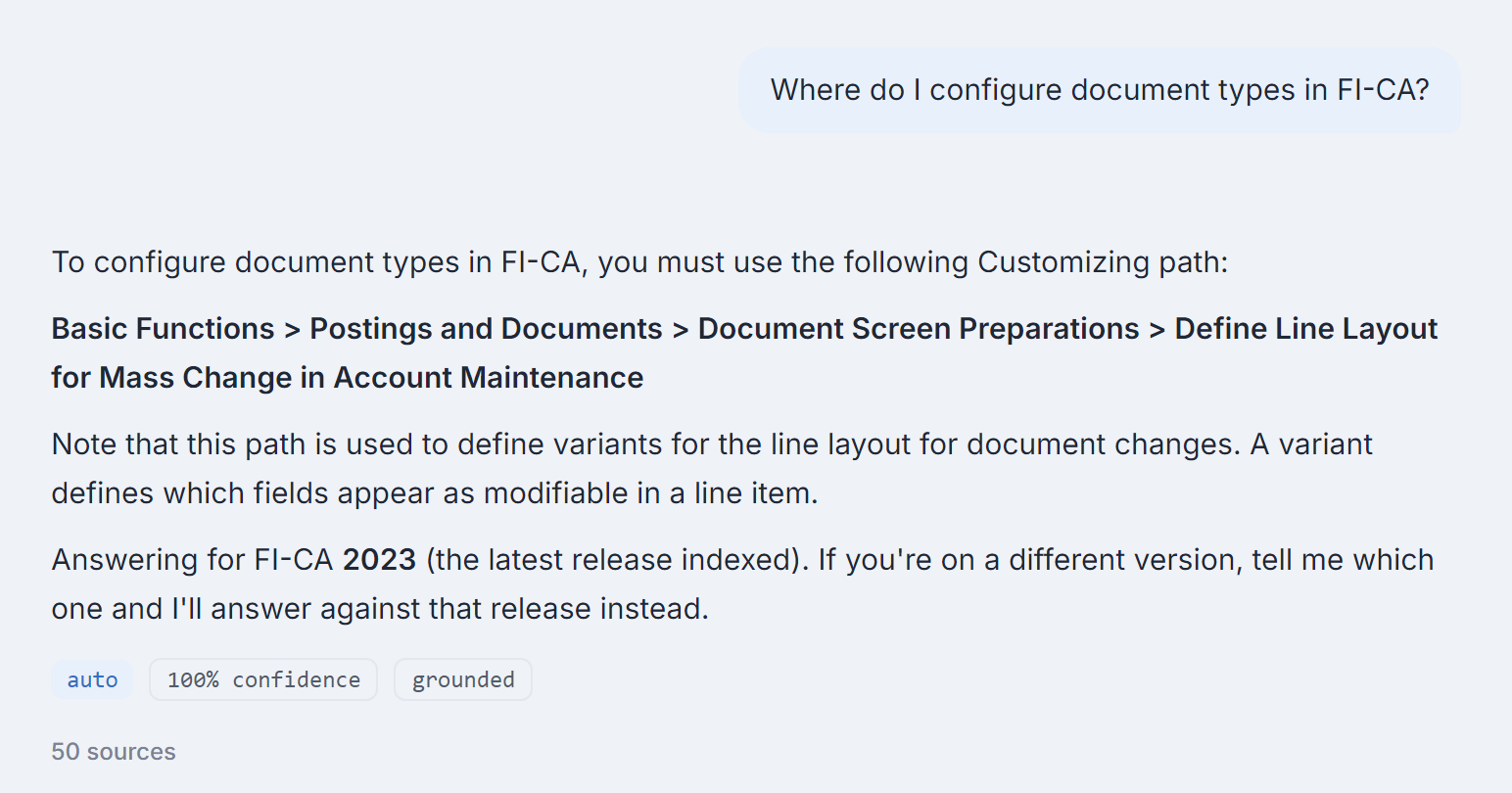
This is the product, answering
Not a mockup. A screenshot taken from the running system on 18 September 2026, cropped to the answer and otherwise untouched.
Read what it gives you: the Customizing path down to the activity, a note on what that path is for, and the release it answered against — because guidance written for one release quietly stops being true in the next.
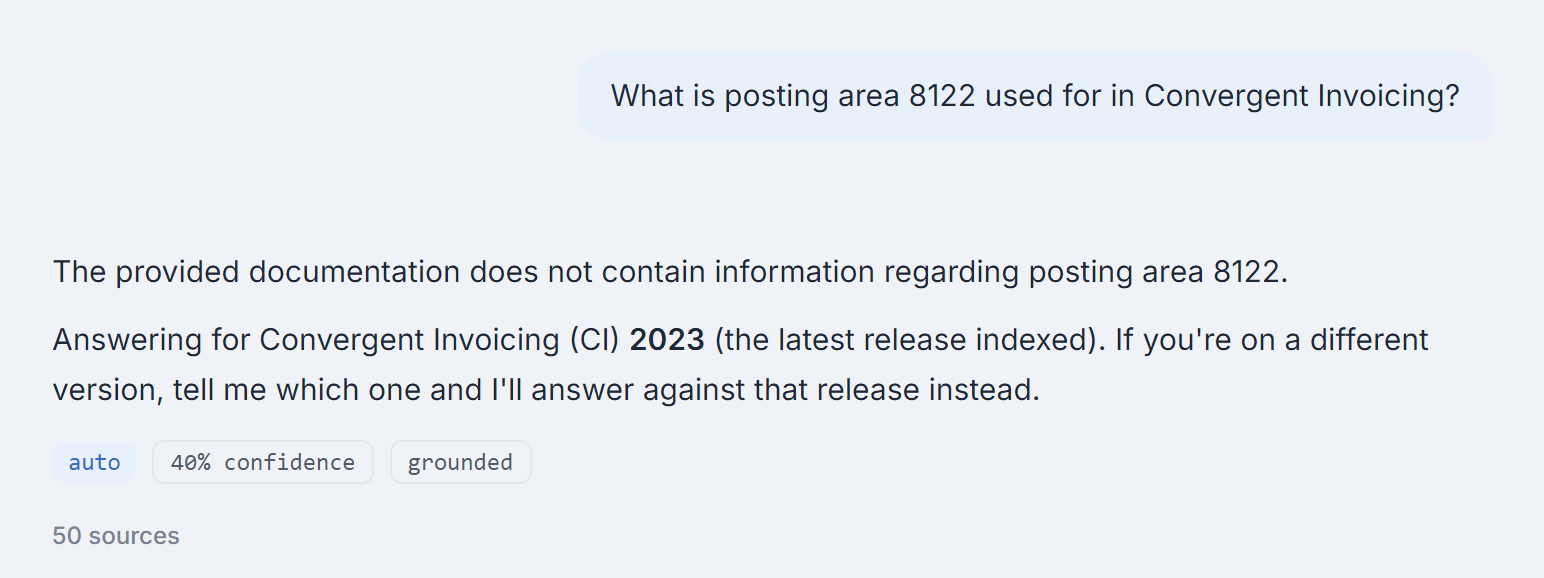
And this is it, refusing
When the passages it retrieved do not carry the answer, it says so and stops. Confidence falls to 40%. Nothing plausible is assembled to fill the gap.
This is the expensive half. An assistant that always produces a paragraph is easy to build, and it is the reason you re-check every transaction code you are given. This one is built the other way round. The cost is that it sometimes stops short — and it tells you when it has.
Eight modules, and what it actually said in each
Not a capability list. Each tile carries a question we put to the running system on 21 September 2026 and the answer it gave, quoted word for word — transaction codes, BAPIs and Customizing paths included.
- CM
Convergent Mediation
How does a collection workflow work in SAP Convergent Mediation?
The collection workflow receives data in the form of ConsumeCycleUDRs … all WorkflowState UDRs must be returned before the next is forwarded into the workflow.
- CC
Convergent Charging
What is a charging plan in SAP Convergent Charging?
A charge plan is a fundamental pricing element … You can rerate from a charge plan activated in contracts using shared allowances within a sharing group.
- CI
Convergent Invoicing
How are billable items created in Convergent Invoicing?
You can use BAPI BAPI_BILLABLEITEMS_CREATE as a standardized interface … This interface is stable even when billable item classes are changed.
- FI-CA
Contract Accounts Receivable and Payable
Where do I configure document types in FI-CA?
Customizing path: Basic Functions > Postings and Documents > Document Screen Preparations > Define Line Layout for Mass Change in Account Maintenance
- SOM
Subscription Order Management
What is a subscription contract in Subscription Order Management?
Created by copying subscription order items from a subscription order document … predefined in Customizing via the action profile IST_ACTION_ORDER_HEAD.
- ABAP
ABAP development
What does FOR ALL ENTRIES do in an ABAP SELECT statement?
The internal table must always be checked using IS NOT INITIAL before the SELECT is executed … In most scenarios, an INNER JOIN is preferred.
- UI5
Fiori and SAPUI5
How do I extend a Fiori elements list report with a custom field?
Adapt manifest.json to include the field in the field group you want to extend … under controlConfiguration.
- O2C
Order to cash
What are the steps of the order-to-cash process in SAP BRIM?
Divided into two main phases: the front-office sales process and the back-office consume-to-cash process.
It takes whatever you already have in front of you
A line out of a log, a half-remembered path, a transaction code, two release numbers. You do not have to know the right words first.
| The question | What you paste or name | What comes back |
|---|---|---|
| A line from an error log | com.sap.SCC.core_server.000267 | What the message means, how severe it is, and the steps SAP gives to clear it |
| Where a setting lives | SPRO → Financial Accounting → Contract Accounts Receivable and Payable | The IMG path to the activity itself |
| Which transaction does it | FKKBIXCIT_CONF | The transaction, quoted from the document that names it |
| Whether a note still applies | 2022 → 2023 | What changed between releases, so guidance from one system holds in yours |
Retrieval first, generation second
The order is the product. A model that writes first and looks second produces SAP specifics that read perfectly and do not exist.
- 01
Retrieve
The question is matched against an index of SAP material, release-versioned and module by module, before a single word is generated.
- 02
Answer from what was found
The specialist model writes from the retrieved passages, naming the transaction codes, tables and configuration paths they contain.
- 03
Strike anything unsupported
Claims the retrieved passages do not support are removed before the answer reaches you. Silence is preferred to a confident guess.
Ask it something you already know the answer to
It is the fastest way to judge it, and the way we would want it judged. Check the transaction it names, and the release it says it named it for.